




For executives and corporate spokespersons without post-production techniques for retention, the prospect of a long-form video interview often brings a specific anxiety: the fear of the “monologue”.
You may possess deep expertise in your field, but being an expert does not necessarily mean you are a professional broadcaster. The concern that a 20-minute discussion on quarterly results or ESG initiatives might appear static, low-energy, or monotonous on screen is valid. In an era of shrinking attention spans, keeping a viewer engaged through a long-form corporate interview requires more than just a compelling script: it requires strategic post-production techniques for retention.
Effective retention in corporate video is rarely about the raw performance alone. It is often about the edit.
Professional editors use specific post-production techniques for retention to manipulate time, pace, and visual variety. These techniques can transform a standard “talking head” interview into a dynamic piece of content that maintains viewer interest without compromising the gravity of the message. This article explores the technical and psychological editing strategies that support executive communication.
Note: Some content in this article may be enhanced or paraphrased by using AI writer software.
The Vivid Media Team
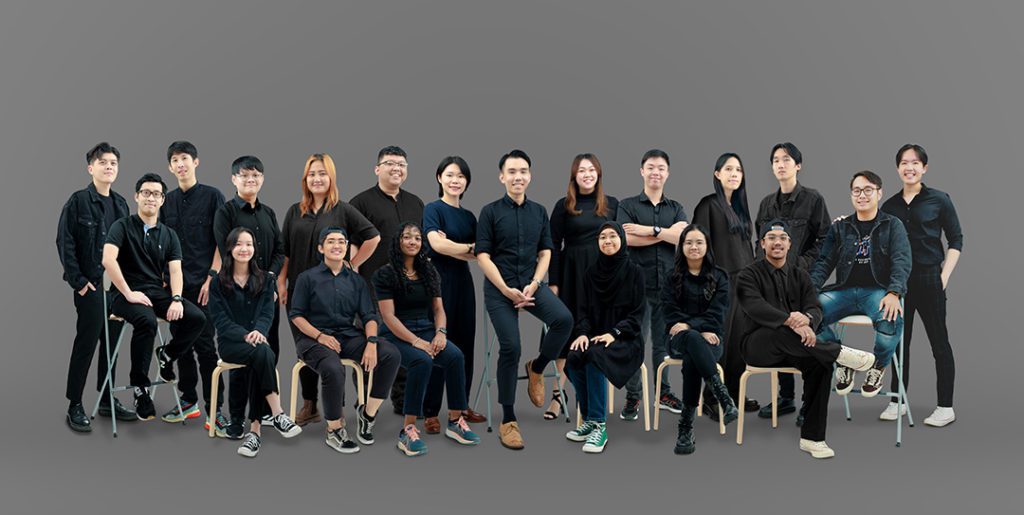
Our team comprises experienced media professionals who specialise in all aspects of video production, from pre-production to post-production. With a lineup that includes videographers, video editors, a director, project coordinators, and a graphic designer, we deliver end-to-end solutions. Our expertise lies in serving corporate clients, with a portfolio covering internal communication videos, brand stories, virtual and hybrid events, and corporate photography.
Please Note: Some videos referenced in this blog article are not produced by Vivid Media. The following videos are sourced from publicly available websites, such as YouTube.
The Psychology of Pacing: Managing “Low Energy”
A common concern for executives is that they may appear “low energy” or camera-shy. Speaking to a lens is vastly different from speaking to a boardroom. The natural pauses, thinking time, and breath intakes that occur in normal conversation can feel dragged out on video.
The “Punch-In” Technique for Visual Retention
If an interview is filmed in high resolution (4K), editors can utilise “punch-ins”. This involves digitally zooming in on the speaker during key moments of emphasis.
- Visual Rhythm: Cutting from a wide shot to a tighter close-up creates a visual reset for the viewer’s brain.
- Artificial Energy: A cut creates a sense of forward momentum. By tightening the framing at the exact moment a new point begins, the editor creates a subtle burst of energy that the speaker may not have physically projected on set.
- Hiding Edits: This technique allows editors to remove stumbles, long pauses, or “ums” seamlessly. We cut out the hesitation and cover the jump with a frame change, making the speaker sound more articulate and continuous.
“Fast Cuts” as Post-Production Techniques for Retention
While appropriate for the subject matter, “fast cuts” act as effective post-production techniques for retention by accelerating the perceived speed of the video. Rather than holding a single shot for 30 seconds, the edit might switch angles or framings every 8 to 10 seconds. This keeps the viewer’s eye active and reduces the likelihood of “zoning out” during complex explanations.
Contextual B-Roll as Post-Production Techniques for Retention
In long-form interviews, the viewer listens to a significant amount of auditory information. Cognitive Load Theory suggests that the brain processes information better when it receives it through dual channels (visual and auditory) rather than just one.
If a CEO discusses “new automated logistics capabilities” while the screen only shows their face, the viewer must imagine those capabilities. This requires mental effort.
Contextual B-roll (supplementary footage) serves to offload this cognitive work.
- Visual Evidence: When the speaker mentions a specific machine or site, the video cuts to footage of that exact asset. This provides immediate context and verification.
- The “Show, Don’t Just Tell” Dynamic: B-roll changes the format from a lecture to a documentary. For example, showing the busyness of the factory floor, or the integration of software, which reinforces the spoken narrative.
By layering B-roll over the interview audio, the editor can also hide significant portions of the “talking head”. This allows for aggressive editing of the audio track by tightening sentences and reordering points for clarity, without the viewer seeing the visual “jump cuts”.
Visual Variation: Advanced Post-Production Techniques for Retention
Ideally, corporate interviews use multi-camera setups such as a wide angle on one camera and a tighter profile on another. However, even with a single camera, post-production can manufacture variety.
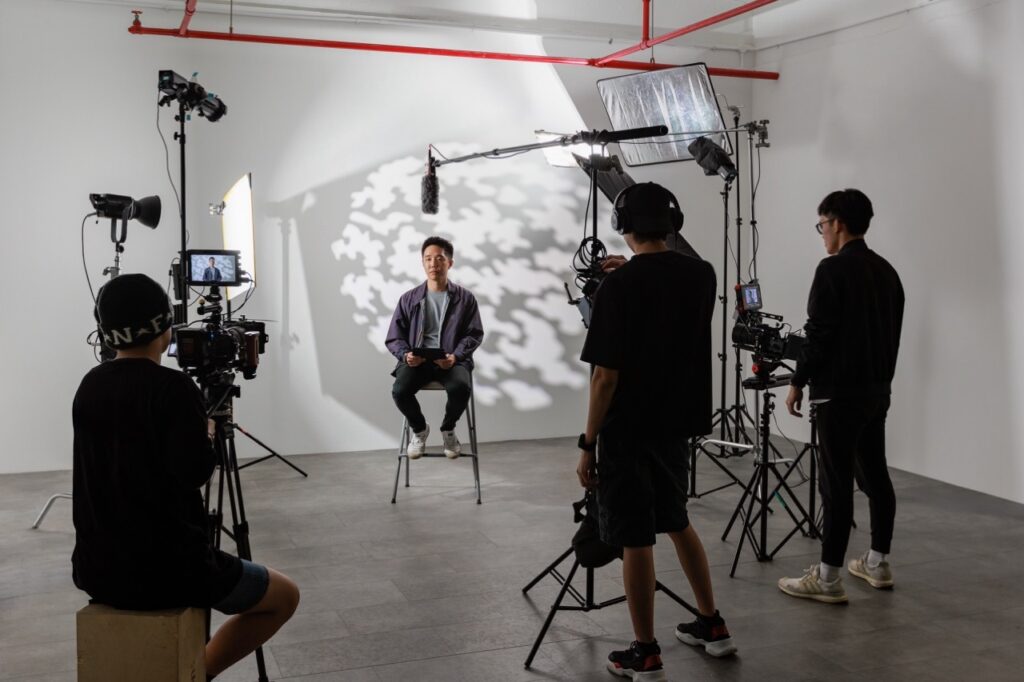
The Digital Multi-Cam Editing Strategy
Filming in 4K resolution allows editors to export in 1080p (HD). This surplus resolution means the editor can crop into different parts of the 4K image without losing quality. From a static camera angle, an editor can create three distinct “shots”:
- The Wide Angle: Showing the executive and the environment.
- The Standard: A medium chest-up shot.
- The Close-up Shot: A tight focus on the face to present more emotion.
Oscillating between these framings keeps the visual experience dynamic. It simulates a high-budget multi-camera production, adding production value and keeping the viewer visually engaged.
Audio Dynamics in Post-Production Techniques for Retention
Sound design plays a subtle but critical role in retention. In a long-form interview, a flat audio track can lead to disengagement.
- J-Cut: The audio of the next scene (or the next topic) begins before the video cuts to it. This pulls the viewer into the next section before they realise the transition is happening.
- L-Cut: The audio of the current scene continues under the next shot (often B-roll). This creates a sense of continuity and flow.
Music Swells and Resolves for Audience Engagement
Background music should not remain at a constant volume. An experienced editor will “swell” the music during transitions or emotional conclusions and “dip” it during complex technical explanations. This dynamic audio mixing guides the viewer’s emotional response, signalling when to pay close attention and when to reflect on a point.
The Mechanics of the “Hook”: The First 5 Seconds
Regardless of the interview’s total length, the retention curve is determined in the first few seconds. A common mistake in corporate videos is starting with a slow introduction: “Hello, I am [Name], the [Title] of [Company], and today I want to talk about…”
Data suggests that viewer drop-off is highest in the first 3-5 seconds.
The “Cold Open” Strategy for Maximum Retention
One of the most effective post-production techniques for retention is restructuring the timeline. We often identify the most impactful, controversial, or value-heavy sentence from the middle of the interview and place it at the very start (0:00).
This immediately gives the video a reason for viewers to stay and watch, after hearing a compelling statement. It also creates a “curiosity gap” where the viewer wants to know the context of that statement, which encourages them to watch the rest of the video. Following this “cold open”, we can introduce the motion graphics title sequence and then settle into the formal introduction.
The Vivid Media Approach: Technical Partnership
At Vivid Media, we view post-production as an extension of your corporate strategy. We understand that executives are busy and may not have the time for multiple takes or acting coaching.
Our role is to use technical proficiency to elevate the material you provide.
- Technical Polishing: We utilise colour grading to ensure skin tones look healthy and professional, and audio mastering to ensure your voice commands authority.
- Narrative Construction: We act as your editorial partners. If a section drags or feels repetitive, we can restructure the narrative flow in the edit to ensure maximum clarity.
- Asset Integration: We seamlessly integrate your slides, data charts, and B-roll to turn a simple interview into a comprehensive presentation.
We do not change your message; we simply tune the delivery channel for maximum retention.
Conclusion: The Edit is the Safety Net
For executives, the pressure to “perform” perfectly on camera can be alleviated by understanding the power of post-production techniques for retention. You do not need to be a high-energy television presenter to command attention.
By relying on dynamic editing, contextual B-roll, and smart pacing, a long-form interview can become a high-value asset that respects the viewer’s time and enhances the speaker’s authority. The goal is not just to record a conversation; it is to craft a viewing experience.
Ready to elevate your corporate communications? Contact Vivid Media to discuss how our post-production expertise can support your next executive interview.
Frequently Asked Questions (FAQs)
Q1: How long should a corporate interview video be?
There is no single “correct” length, but retention generally drops as time increases. For deep-dive topics, 3 to 5 minutes is often a sweet spot for LinkedIn or corporate newsletters. If the raw interview is 20 minutes long, we recommend editing it down to a “Highlights” version for general distribution, while keeping the full version for internal stakeholders or interested investors.
Q2: Can you make a “boring” topic look interesting?
Post-production can significantly improve engagement. Techniques like “fast cuts”, motion graphics, and dynamic music can inject energy into static topics. However, the core content must still hold value for the audience. Editing enhances the delivery, but the subject matter drives the interest.
Absolutely. This is a highly efficient strategy. From one long-form interview, we can isolate specific questions and answers to create multiple 30-to-60-second vertical videos (Shorts/Reels). This maximises the ROI of your filming session and provides a month’s worth of content from a single hour of your time.
Q4: Do I need to provide the B-roll footage?
It depends on the context. If you are discussing specific proprietary machinery or internal teams, we highly recommend filming authentic B-roll of those subjects. This adds context and prevents the video from feeling generic. If you do not have footage, we can sometimes use high-quality stock footage, but custom-filmed B-roll always builds greater trust.
Q5: What are “J-Cuts” and “L-Cuts”, and why do they matter?
These are audio editing techniques used to create a natural flow. A “J-Cut” is when you hear the audio of the next scene before you see it, which subconsciously pulls the viewer into the next topic. An “L-Cut” is when the audio of the current scene continues while the visual changes to B-roll. Using these techniques prevents the video from feeling like a series of disjointed clips and mimics the natural flow of human observation.
Vivid Media Video Production Team
We hope this article has given you useful insights into media production. Our team is ready to collaborate with you, bringing together our combined expertise to meet your media production needs. Our key specialisations include:
- Corporate video production
- Live streaming for virtual and hybrid events
- Corporate photography
- Event photography and videography
To learn more about our team and what we do, visit our About Us page.
Get a Price Quotation
Some projects are straight-forward while others can be complex, drop us a message with your project requirements. Our project coordinator will get in touch with you to provide a price quotation.


