




If you are an e-commerce brand relying on generic videos for social media, you may be missing opportunities to connect with your audience.
Platforms like TikTok, Instagram Reels, and YouTube Shorts now prioritise content that is tailored to their format and user behaviour. To stand out, brands need a consistent flow of content that is both relevant and well-produced, with a clear focus on driving engagement and conversions.
At Vivid Media, we work with brands and distributors to produce professional social media videos without the typical overhead of a traditional advertising agency. To illustrate how we achieve this, we are breaking down our process, from pre-production to post-production, using our recent campaign for the global food brand Jin Mai Lang.
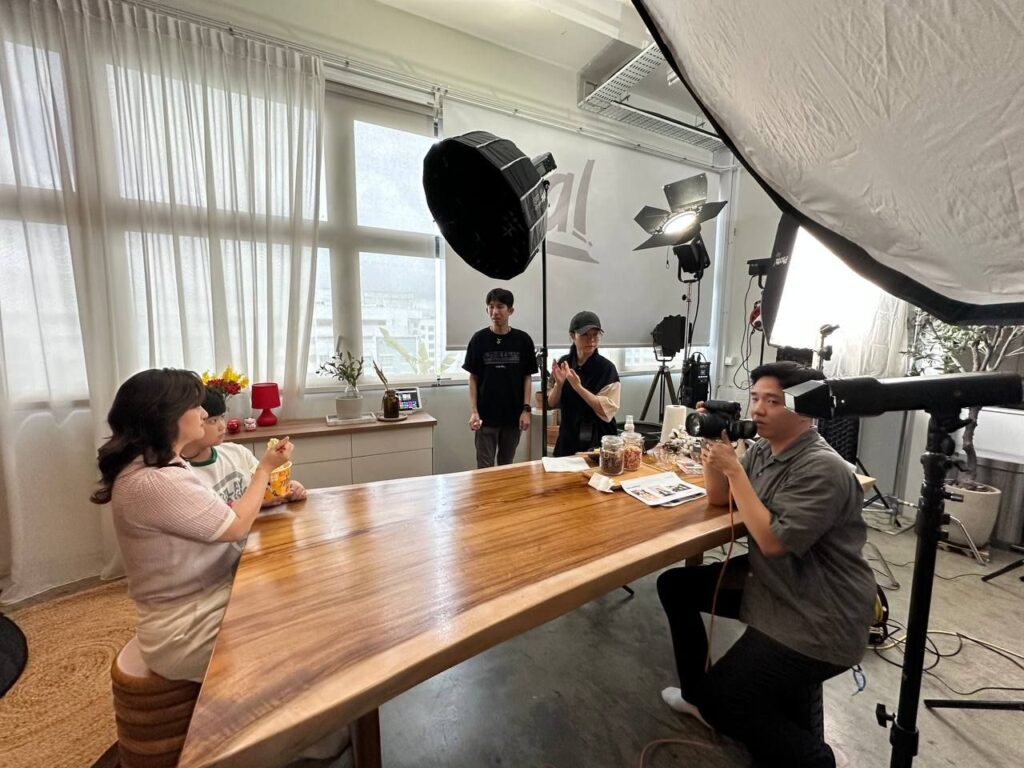
Case Study: Elevating Jin Mai Lang for Social Media Video
For a recent social media video project with the food and beverage brand Jin Mai Lang, the objective was to produce high-quality, appetite-focused visuals designed specifically for digital platforms. The content needed to work across both landscape website formats (16:9) and vertical mobile feeds (9:16), including platforms like TikTok, Reels, and YouTube Shorts.
One common challenge in social media video production is balancing quality with efficiency. Producing separate assets for different platforms can increase both cost and production time, especially when it involves multiple shoot days.
To address this, the project was structured around a single production pipeline. The goal was to capture footage that could be adapted across formats, while keeping the workflow streamlined for social media use.
Pre-Production: Planning for Multi-Platform Scale
For the Jin Mai Lang social media video, efficiency was considered from the early planning stage. The project was structured to accommodate both portrait and landscape formats within a single shoot day, allowing the same set of footage to be adapted across multiple platforms.
A significant portion of the work took place during pre-production. Technical decisions were made in advance to ensure the captured footage could be used flexibly in post-production. This included planning for framing, composition, and how each shot would translate across different aspect ratios commonly used on platforms like TikTok and YouTube.
Choosing Open-Gate Capable Cameras
For Jin Mai Lang, the production was planned around open-gate filming. Most cameras typically record in a standard widescreen format, which can lead to image loss when cropped into vertical formats.
By using the full height of the camera sensor, open-gate filming captures a larger image area. This provides more flexibility during editing, making it possible to extract both vertical and horizontal compositions from the same shot.
This approach supports multi-platform delivery without requiring separate shoots for each format, while still maintaining consistent framing across outputs.
Centre-Cross Framing & Smart Set Design
Composition was planned with platform constraints in mind. Vertical formats offer less horizontal space, so framing needed to be carefully controlled to ensure key elements remained visible.
Safe zones were mapped out on the director’s monitor to guide framing throughout the shoot. These guides helped ensure that important visual elements would not be obstructed by platform UI elements such as captions or buttons.
Blocking was also planned in advance. Key actions, such as the family eating together, were positioned to remain centred within the frame. This allows the footage to adapt more consistently across different formats.
The set design followed the same principle. Elements like the final product stack were positioned based on how they would appear in both vertical and horizontal outputs. This approach was applied throughout the Jin Mai Lang video to maintain consistency across formats.
Production: Bringing TVC Quality to the Noodle Bowl Social Media Video
For the Jin Mai Lang social media video, efficiency was considered from the early planning stage. The project was structured to accommodate both portrait and landscape formats within a single shoot day, allowing the same set of footage to be adapted across multiple platforms.
Rather than treating it as quick content creation, the production was planned in advance. Shots were structured to focus on key product elements such as texture, colour, and the overall dining context.
Highlighting Texture with Lighting
Lighting played a central role in shaping the final look of the video. Instead of relying on flat ambient lighting, we used shaped, directional lighting with warm tones to create a welcoming, family-oriented atmosphere that supports the narrative of a comforting meal.
For product close-ups, the lighting setup became more technical. We carefully positioned key lights and controlled shadows to bring out depth and texture. This approach allowed the Authentic Knife Cut Noodles to appear more springy and defined, while the thick beef paste looked richer and more indulgent.
Subtle highlights were also introduced to enhance the gloss and moisture of the ingredients, making each frame feel more tactile. These details are important because they simulate the sensory experience that viewers cannot physically access through a screen.
Capturing Sensory Details
To further elevate the visuals, we used professional macro lenses to capture extreme close-ups that would not be possible with standard setups. This included moments such as ingredient packets dropping into the cup, seasoning dispersing in water, and steam rising as hot water is poured in.
These shots were not just aesthetic choices but strategic ones. Close-up macro footage helps translate smell, taste, and texture into visual cues that viewers can immediately understand. The rising steam suggests warmth and freshness, while the movement of ingredients creates a sense of realism and immediacy.
We also paid attention to timing and motion, ensuring that each action was captured at the right speed and angle. This allows the footage to feel natural while still being visually engaging when edited into short-form content.
By focusing on these small but impactful details, the final video becomes far more appetizing and immersive. This is especially important for FMCG products, where strong visual storytelling is needed to compensate for the lack of physical interaction with the product.
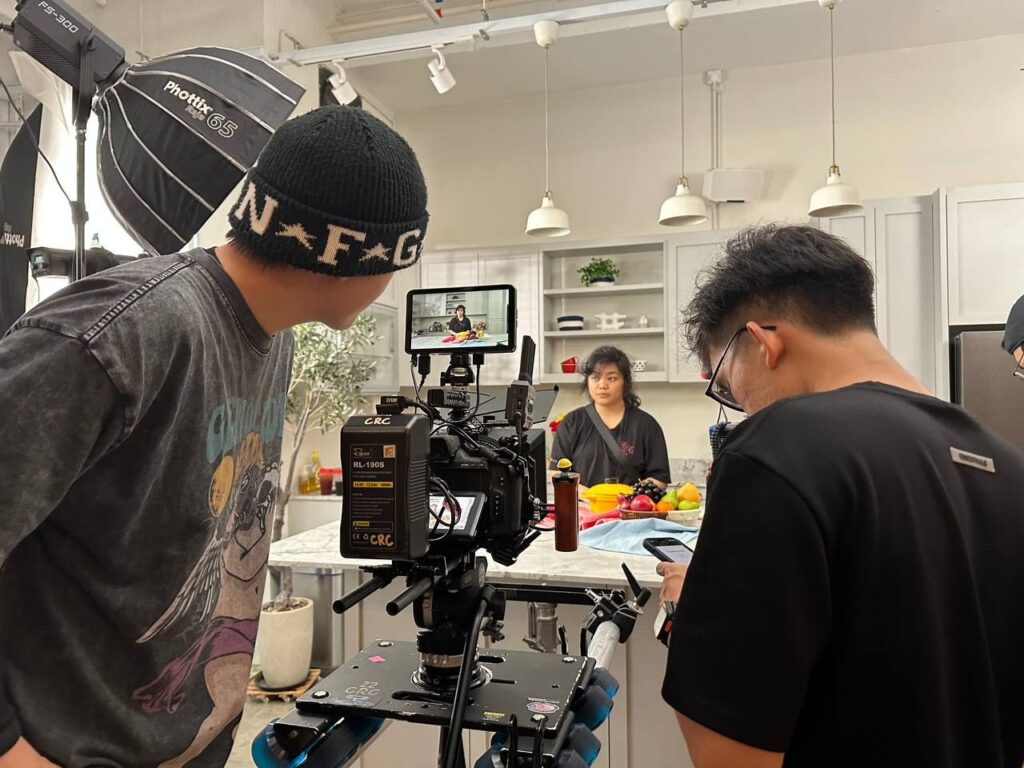
Post-Production: Editing for Retention and Psychology
Even with high-quality footage, the final edit must align with social media viewing habits. Traditional TVCs often feature slower shots lasting 3 to 5 seconds. In contrast, our social edit for Jin Mai Lang was designed to be more dynamic and fast-paced.
Visual Psychology in the Hook
Many social videos begin with a straightforward product shot. Instead, we applied visual psychology to create a stronger opening.
Rather than starting with an empty noodle cup, we opened with the emotional payoff. The first shot shows the mother’s face, lit with TVC-quality lighting against a softly blurred background, expressing pure satisfaction. This approach captures attention immediately by selling the feeling of a warm, comforting meal before introducing the preparation process.
High-Resolution Digital Zooms
The opening sequence features multiple quick cuts to maintain momentum. Because we filmed on high-resolution cinema cameras, we could apply digital zooms and subtle pans in post-production without losing image quality.
This adds continuous visual movement, which helps keep viewers engaged and reduces drop-off.
Integrated Sound Design
We layered in subtle audio cues, such as slurping and the sound of pouring water, to enhance the viewing experience.
These details help bridge the gap between high-end visuals and native social content, making the video feel both polished and platform-appropriate.
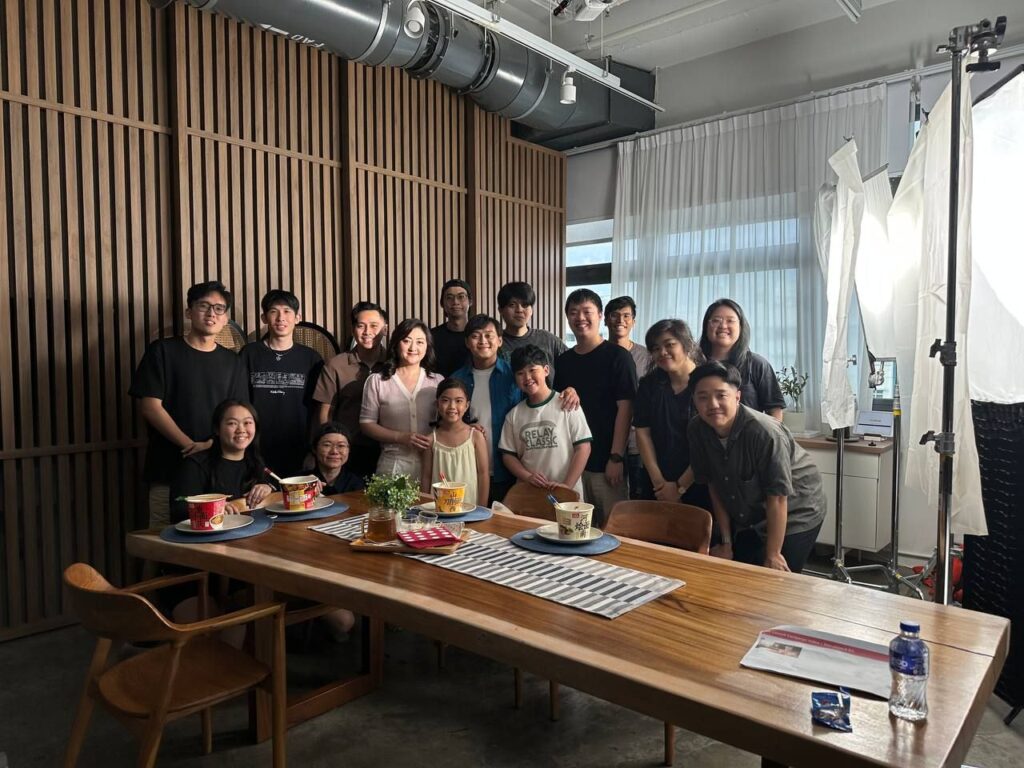
This workflow offers a practical solution for brands and distributors seeking the visual quality of a professional TVC, but adapted for social media. Instead of choosing between expensive, slow-moving traditional agencies and low-quality smartphone footage, this approach bridges the gap.
By maximizing what is captured in a single day, from open-gate framing to high-end macro lighting, brands can achieve TVC-level visuals for social platforms. These conversion-focused videos look and feel like high-budget commercials, yet are produced, formatted, and paced natively for platforms like TikTok, Reels, and YouTube, all within a manageable timeline and budget
Reference from Social Media Campaigns
To better understand how high-end production aligns with social media pacing, here are three distinct styles that are commonly seen in current social content. (Note: These are reference examples sourced online for inspiration and were not produced by Vivid Media.)
Screen-to-Real-Life VFX: TikTok’s “Now You Know” Campaign
This style creates a striking illusion where physical products appear to move from the digital screen into real life. It combines seamless action match-cuts with VFX to blur the boundary between on-screen content and the viewer’s space.
For e-commerce brands, one key challenge is the gap between the screen and the buyer. This technique helps reduce that distance by making the product feel more immediate and tangible. Successful execution requires careful pre-production planning, including matching lighting, shadows, and motion to ensure the transition feels natural in post-production.
A notable example is TikTok’s “Now You Know” campaign by We Are Social, where everyday objects are thrown through the phone screen and appear to land in the viewer’s world, adapted effectively for vertical social formats.
The Playful Stop-Motion Approach
This format moves away from traditional continuous video and focuses on a sequence of still images combined with motion and text. By arranging frames in quick succession, it creates a slightly choppy but highly rhythmic visual style that feels dynamic and distinctive.
For e-commerce brands, especially in categories like snacks, cosmetics, or small accessories, this approach can make simple product interactions more engaging. Actions such as unboxing, applying a product, or taking a bite can be broken down into small moments, making the content feel more playful and visually interesting.
It also relies heavily on post-production. Timing, transitions, and sound design need to be carefully aligned to create a smooth viewing experience, even within a deliberately stylised format.
A well-known example can be seen in campaigns by Oreo. Instead of relying on standard live-action shots, the content often uses stop-motion techniques to animate the product. The cookie appears to move, stack, or split on its own, often paired with simple on-screen text and sound cues. This creates a format that feels both creative and well-suited for short-form social media.
FAQ
The most effective videos answer real customer questions and show how a product fits into everyday use. High-performing content demonstrates how the product works and what problems it solves, combining relatability with clear, professional visuals.
When filming social media videos for e-commerce products, clarity should always come first.
The viewer should be able to immediately understand what the product is and how it is used, even without sound. This means keeping the framing tight, reducing unnecessary distractions, and making sure the product is always the focus.
The simplest way is to focus on how the product is presented rather than how complex the setup is.
A clear, stable shot that shows the product in use will almost always perform better than a visually busy scene. When the viewer can quickly understand what the product does and how it fits into real life, the video feels more useful and engaging.
How can e-commerce brands create high-quality videos on a limited budget?
Efficiency in pre-production is key. By partnering with a production team that uses techniques like simultaneous multi-format framing (shooting 16:9 and 9:16 together) and thorough shot lists, brands can capture agency-level visuals without the higher costs typically associated with multi-day productions.
Planning Your Social Media Video Production With Vivid Media
Scaling your video content requires more than just picking up a phone. It requires a strategic approach to lighting, framing, and editing. By focusing on production efficiency and TVC-level quality, brands and distributors can build trust and drive conversions without overextending their budgets.

If you are looking to develop a more structured and scalable approach to social media video production, the team at Vivid Media can support you in planning, filming, and producing content that aligns with your business goals.


